Wing nut failure creates serious risks in concrete formwork systems. When fastening components crack or deform under pressure, contractors face delays, safety concerns, and material loss. Therefore, understanding the causes of wing nut failure helps teams protect structural stability and maintain productivity.
Instead of reacting after damage occurs, contractors should identify risk factors early and apply preventive measures consistently.
Common Causes of Wing Nut Failure in Tie Rod Systems
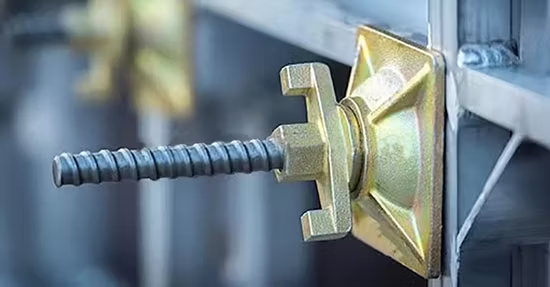
First, incorrect thread compatibility weakens the connection. Even a slight mismatch between tie rod and wing nut reduces load distribution.
1. Incorrect Tie Rod Compatibility
Using mismatched thread pitch or diameter creates uneven load transfer. Even if the component fits loosely, under concrete pressure it may strip or crack.
Common sizes in Indian and export markets:
- 12mm – Light slab applications
- 16mm – Standard wall formwork
- 17mm – Heavy-duty industrial systems
Precision threading is critical.
2.Low-Grade Casting and Structural Weakness
Many low-cost products fail due to internal air pockets in casting. These micro-voids weaken structural strength.
Under pressure, stress concentrates at the wing base or threaded core leading to sudden cracking.
High-pressure wall systems require uniform, dense casting especially in oil & gas, refinery, and marine construction environments.
3.Over-Tightening During Installation
Excessive torque does not increase safety. It damages thread integrity.
Scaffolding crews often overtighten to “be safe,” but over-compression causes premature deformation. Proper tightening should secure alignment without exceeding material limits.
4.Reuse Without Inspection
Rental scaffolding companies and large contractors reuse components frequently. Over time:
- Threads wear out
- Surface corrosion develops
- Wings bend slightly
Without inspection cycles, these weak points lead to failure during high-load pours.
5.Using Standard Hardware in High-Pressure Walls
Retaining walls, thick core walls, and industrial foundations create much higher lateral pressure.
Using standard hardware in these zones increases failure probability. Heavy-duty variants must be used for high-pressure environments.
Early Signs of Structural Hardware Failure
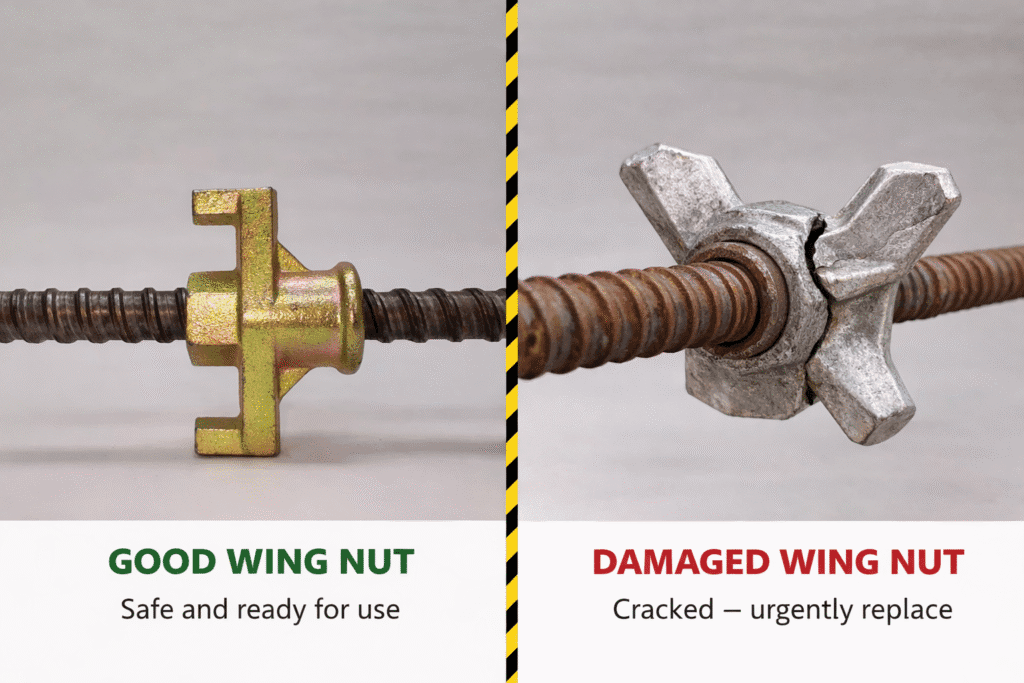
Before complete breakage occurs, warning indicators appear:
- Thread stripping during tightening
- Uneven rotation resistance
- Hairline cracks near wing joints
- Visible deformation after stripping
- Surface rust in humid or marine zones
Routine inspection before each concrete pour dramatically reduces risk.
Industrial Applications With Higher Wing Nut Failure Risk
Wing nut failure risk increases in:
- Oil & gas facilities
- Refineries and petrochemical plants
- Shipbuilding yards
- Industrial insulation projects
- High-rise infrastructure
- Scaffolding rental fleets
These sectors demand hardware that performs under repeated stress cycles.
For deeper understanding of concrete pressure dynamics, review engineering principles here: https://www.engineeringtoolbox.com/concrete-pressure-formwork-d_949.html
How to Prevent Wing Nut Failure on Site
Prevention is systematic, not accidental.
✔ Use Correct Thread Matching
Always verify tie rod and internal threading alignment.
✔ Choose Heavy-Duty Casting for High Loads
Thicker walls require higher load-bearing capacity.
✔ Implement Inspection Protocols
Check threads, wings, and surface condition before reuse.
✔ Select Corrosion-Resistant Finishes
Zinc-plated or coated finishes improve life cycle in humid regions.
✔ Source From Precision Manufacturers
Dimensional accuracy reduces stress concentration.
What Professional Contractors Do Differently
Experienced scaffolding contractors do three things:
- Standardize tie rod sizes across projects
- Separate heavy-duty inventory from slab-use inventory
- Maintain rotation and inspection logs
This improves safety compliance and reduces liability.
Recommended Heavy-Duty Wing Nut Solution
For projects requiring consistent thread accuracy and dense casting quality, review our precision-cast Wing Nut for Tie Rod systems:
👉 https://www.amcoexports.com/product/wing-nut-tie-rod/
For selection guidance, you may also read:
👉 https://www.amcoexports.com/how-to-choose-wing-nut-for-formwork/
Final Takeaway for Scaffolding & Construction Professionals -wing nut failure
Wing nut failure is preventable.
It happens when:
- Compatibility is ignored
- Quality is compromised
- Inspection is skipped
- Load requirements are underestimated
It is prevented when:
- Correct thread size is matched
- Heavy-duty casting is selected
- Routine inspection is implemented
- Manufacturing standards are verified
For contractors managing multiple sites, scaffolding rental fleets, oil & gas installations, or industrial builds hardware selection is not a minor detail. It is a structural decision.
Improve Site Safety Today
If your projects involve high-pressure wall systems or repeated reuse cycles, upgrading fastening components is a practical step toward reducing risk.
Explore technical specifications and available sizes here:
👉 https://www.amcoexports.com/product/wing-nut-tie-rod/
For bulk supply, export inquiries, or technical support:
📞 +91 98888 82322
📧 amcosales1@gmail.com
Follow AMCO Exports
Instagram: https://www.instagram.com/amcoexports/
LinkedIn: https://www.linkedin.com/in/amcoexports/
Frequently Asked Questions
What causes wing nut failure in formwork systems?
Wing nut failure typically occurs due to incorrect tie rod compatibility, low-grade casting quality, excessive tightening, repeated reuse without inspection, or using standard components in high-pressure wall applications.
How can contractors prevent wing nut failure on site?
Contractors should match correct tie rod sizes (12mm, 16mm, 17mm), use heavy-duty variants for retaining walls, inspect threads before reuse, and avoid over-tightening during installation.
Is heavy-duty casting necessary for high-pressure wall systems?
Yes. Retaining walls and industrial foundations generate higher lateral pressure. Heavy-duty, dense casting improves load-bearing capacity and reduces structural risk.
How often should wing nuts be inspected?
Wing nuts should be inspected before every reuse cycle. Check for thread wear, cracks near wing joints, corrosion, and deformation after stripping.
Can corrosion increase the risk of hardware failure?
Yes. Moisture exposure and rust weaken structural integrity over time. Zinc-plated or coated finishes improve durability in humid or marine environments.