
Construction Equipment Comparison | AMCO Exports
A Stub Setting Prop is designed for use in transmission tower foundation work, where tower stubs must be positioned according to approved project drawings. Unlike conventional Acrow Props and adjustable steel props, it serves a specialised stub-setting application.
This guide explains the differences between these three products, their typical applications and what transmission line contractors should check before choosing a prop for a project. Explore the product specifications from AMCO Exports.
In construction and infrastructure work, selecting a prop based only on its appearance or adjustability can be misleading. The intended purpose, connection details, dimensions, stability and approved design all matter.
For transmission tower foundations, steel stubs must be set to the geometry specified in the approved drawings before concrete placement. The equipment used to hold them in position must suit the tower configuration and the project’s approved setting method.
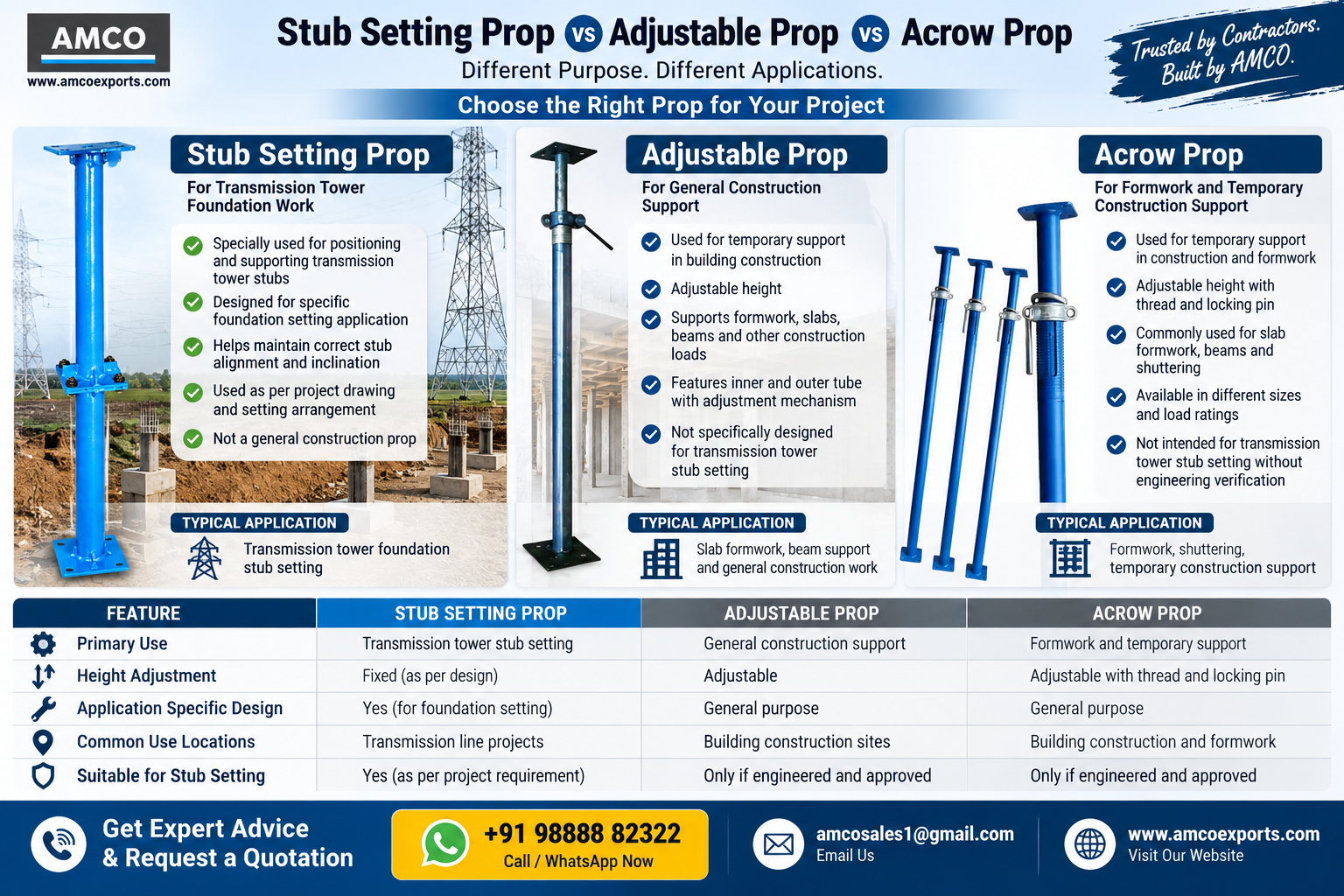
Quick answer: A Stub Setting Prop is intended for a specialised transmission tower foundation-setting application. An Acrow Prop or adjustable steel prop is generally used for temporary construction support. These products should not be considered interchangeable unless their suitability has been verified for the intended application.
1. What Is a Stub Setting Prop?
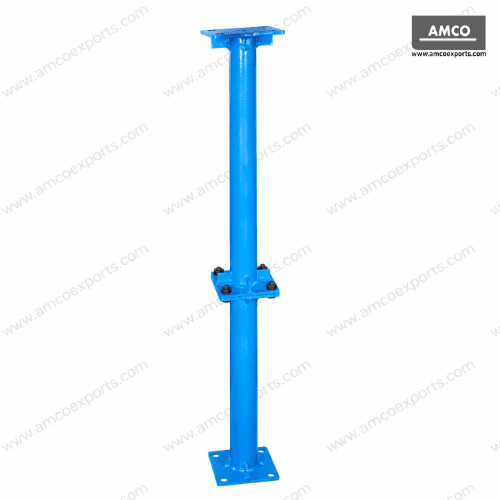
AView product specificationsis intended for use in setting transmission tower foundation stubs. These stubs form the embedded connection points for the tower legs, so their positions and inclinations must correspond to the approved foundation and tower drawings.
During foundation preparation, an appropriate setting arrangement helps hold the stubs in their required positions while the foundation work proceeds. The exact arrangement and checking procedure depend on the project design and specifications.
Typical characteristics
- Intended for transmission tower foundation stub-setting work.
- Selected according to the approved tower and foundation arrangement.
- Used as part of a setting and alignment process, not as a general-purpose slab prop.
- Requires correct positioning, surveying and inspection according to project requirements.
2. What Is an Acrow Prop?
An Acrow Prop is a type of adjustable steel prop commonly used to provide temporary vertical support in construction. Depending on its design, it may feature inner and outer tubes, a height-adjustment mechanism, a locking pin and a threaded adjustment collar.
Acrow props are commonly associated with formwork, shuttering and temporary support applications. The permitted load and working range depend on the specific prop model and its configuration.
Typical characteristics
- Adjustable height for specified temporary support applications.
- Used in formwork and construction support systems.
- Available in different designs and load ratings.
- Not automatically suitable for holding transmission tower stubs without an engineered, approved arrangement.

3. What Is an Adjustable Steel Prop?
An Adjustable Steel Prop is a general category of temporary steel support that can be adjusted to a required height within its designed range. Acrow props are commonly considered a type of adjustable steel prop, so these names can overlap in the construction market.
Adjustable props are widely used for slab shuttering, beam support, RCC formwork and other temporary construction applications. Their design, adjustment range, tube dimensions, end plates and rated capacity vary by model.
Typical characteristics
- Height adjustment for construction support work.
- Used in slab, beam and formwork applications.
- Available in different sizes, finishes and duty classes.
- Must be selected according to the required load and approved application.

Stub Setting Prop vs Acrow Prop vs Adjustable Steel Prop: Key Differences
The main difference is the intended application. An adjustable mechanism alone does not determine whether a prop is suitable for a particular engineering task.
| Comparison factor | Stub Setting Prop | Acrow Prop | Adjustable Steel Prop |
|---|---|---|---|
| Primary application | Transmission tower foundation stub setting | Temporary construction support | Temporary construction support |
| Main purpose | Forms part of a setting arrangement for positioning tower stubs | Supports specified construction loads | Provides adjustable support within its design limits |
| Typical project | Transmission line foundation work | Building, formwork and shuttering work | Slab, beam and RCC formwork |
| Height adjustment | Depends on the specific design | Usually adjustable within the model’s range | Adjustable within the model’s range |
| Connection arrangement | Must suit the approved stub-setting design | Standard prop ends unless specially designed otherwise | Depends on the product and accessories |
| Transmission tower use | Subject to tower drawings and project procedure | Only if specifically assessed and approved | Only if specifically assessed and approved |
Why Is a Stub Setting Prop Used for Transmission Towers?
1. Tower stub position must match the approved design
Transmission tower foundations are designed around specific tower-leg geometry. Stub positions, spacing, level and inclination must follow the approved drawings and the project’s specified tolerances.
2. Stub setting happens before concrete placement
The foundation stubs need to be held in their required positions while foundation work proceeds. A suitable setting arrangement supports this task, alongside surveying and inspection.
3. The application is different from supporting a slab
A slab prop is generally selected to support temporary construction loads. Stub setting instead concerns the position and stability of foundation stubs relative to the tower geometry. The connection arrangement and required checks are therefore application-specific.
4. The method depends on the project
Transmission projects may specify a template method or an approved prop-based method. Site conditions and tower configuration can affect the chosen procedure, but the method must follow the project’s engineering requirements and approval process.
5. Correct setting helps avoid erection problems
Inaccurately positioned stubs can create difficulties when tower legs are assembled. Accurate survey checks and compliance with the approved foundation drawings are therefore essential before concrete placement and during the required inspection stages.
AMCO Exports Stub Setting Prop Specifications
AMCO Exports supplies a Stub Setting Prop intended for transmission tower foundation applications. The following dimensions are based on the product details provided for this article.
| Parameter | Specification |
|---|---|
| Product name | Stub Setting Prop |
| Pipe specification | NB40 × 3.2 mm |
| Pipe length | 490 mm |
| Overall height | 500 mm |
| Base plate dimensions | 125 × 125 × 5 mm |
| Stiffener plate dimensions | 30 × 30 × 5 mm |
| Base plate hole diameter | Ø13 mm |
| Centre opening | Ø43 mm |
| Pipe material grade | YST 240 as per IS 1161 |
| Plate material grade | Grade A as per IS 2062 |
View the Stub Setting Prop product page for product information or contact AMCO Exports to confirm the latest details. Unit weight and load capacity should be confirmed with the manufacturer rather than assumed.
How to Choose the Right Prop for Your Project
- Identify the application: transmission tower stub setting, slab support or general formwork.
- Check the drawings: verify dimensions, connection details and the approved setting arrangement.
- Confirm the load requirements: request verified load data for the specific model and configuration.
- Check adjustment requirements: confirm the required height or setting geometry before ordering.
- Confirm materials and finish: ensure the specified grade, fabrication and surface finish meet project requirements.
- Obtain engineering approval: do not substitute a general-purpose prop for a dedicated arrangement without approval.
Related AMCO Exports Products
Frequently Asked Questions
What is the difference between a Stub Setting Prop and an Acrow Prop?
A Stub Setting Prop is intended for transmission tower foundation stub-setting work. An Acrow Prop is generally used for temporary construction support and formwork. Suitability for tower stub setting must be confirmed against the project design and approved procedure.
Is an Acrow Prop the same as an Adjustable Steel Prop?
The terms often overlap. Acrow prop is commonly used to describe an adjustable steel prop, although product designs and specifications vary between manufacturers and models.
Why are Stub Setting Props used in transmission tower foundations?
They form part of a setting arrangement intended to position and support tower foundation stubs according to the approved tower and foundation drawings before concrete placement.
Can an ordinary adjustable steel prop be used for tower stub setting?
Not automatically. The prop, its connections and the complete setting arrangement must be technically assessed and approved for the intended use.
Does every transmission tower foundation use Stub Setting Props?
No. The approved construction method may use a template or another permitted arrangement. The project specification, tower design and site conditions determine the appropriate method.
What information should I share when requesting a Stub Setting Prop quotation?
Share the required dimensions, drawings, material specifications, quantity, surface finish and any project-specific requirements. The manufacturer can then review the enquiry and confirm the details that need to be finalised.
Looking for Stub Setting Props for Transmission Tower Projects?
Contact AMCO Exports to discuss stub setting prop dimensions, project requirements and a quotation. For Acrow Props or Adjustable Steel Props, share your required size and application so the appropriate product can be identified.
AMCO Exports — Trusted by Contractors. Built by AMCO.
About AMCO Exports: AMCO Exports supplies scaffolding, formwork and construction support products from Jalandhar, Punjab, India, for customers in India and international markets.