Introduction: Cuplock vs Ringlock Scaffolding Explained Simply
If you’re trying to decide between Cuplock vs Ringlock scaffolding for your next project, the first step is understanding how these two modular systems differ. Both are strong, widely used, and trusted—but they serve different types of construction needs. This guide walks you through every essential detail: how each system connects, their components, ideal applications, cost factors, and what to choose based on your site requirements.
The Fundamental The Fundamental Design Difference: Cuplock vs Ringlock Connection Systems
How Cuplock vs Ringlock Scaffolding Connects
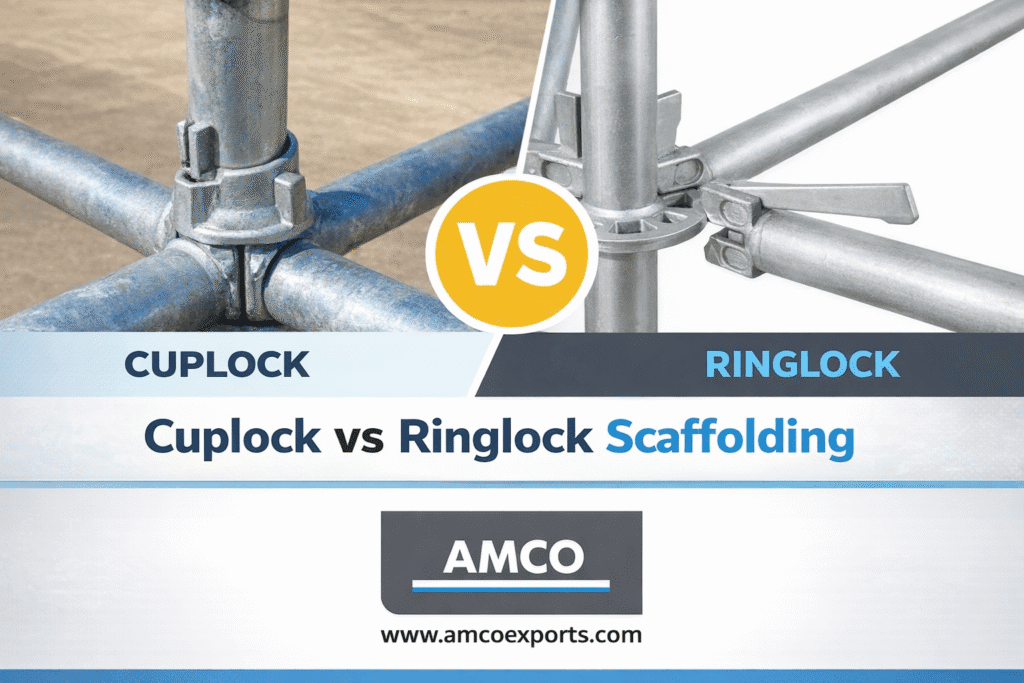
The core distinction lies in the locking mechanism. The Cuplock scaffold system uses a simple yet robust cup-and-wedge method: horizontal members slot into fixed cups on the verticals and are locked with a hammer-driven wedge. In contrast, the Ringlock system (or rosette scaffolding) features a ring with multiple slots. Components connect using a self-locking wedge pin, allowing connections at various angles from a single point, which offers superior geometric flexibility.
Cuplock Connection
A cup-and-wedge method. Ledgers fit into fixed top cups on the standard and lock in place with a hammer-driven wedge.
Ringlock Connection
A rosette with multiple slots offers multi-directional connection options. The wedge pin locks automatically, giving excellent geometric flexibility.
Component Breakdown: Cuplock vs Ringlock Scaffolding Parts
A clear understanding of individual parts is essential for specification and ordering.
Primary Components for Each System
Cuplock System Components
Cuplock System Components:
- Standards: Vertical tubes with welded cups.
- Ledgers: Horizontals with a forged blade end.
- Transoms: Load-bearing horizontals for platform support.
- Swivel Braces: Diagonals for lateral stability.
Interested to Buy Cuplock System & Accessories
The Cuplock Horizontal Ledger works as part of a complete Cuplock scaffolding system. To build a safe and fully compatible structure, contractors typically combine ledgers with the following Cuplock accessories:
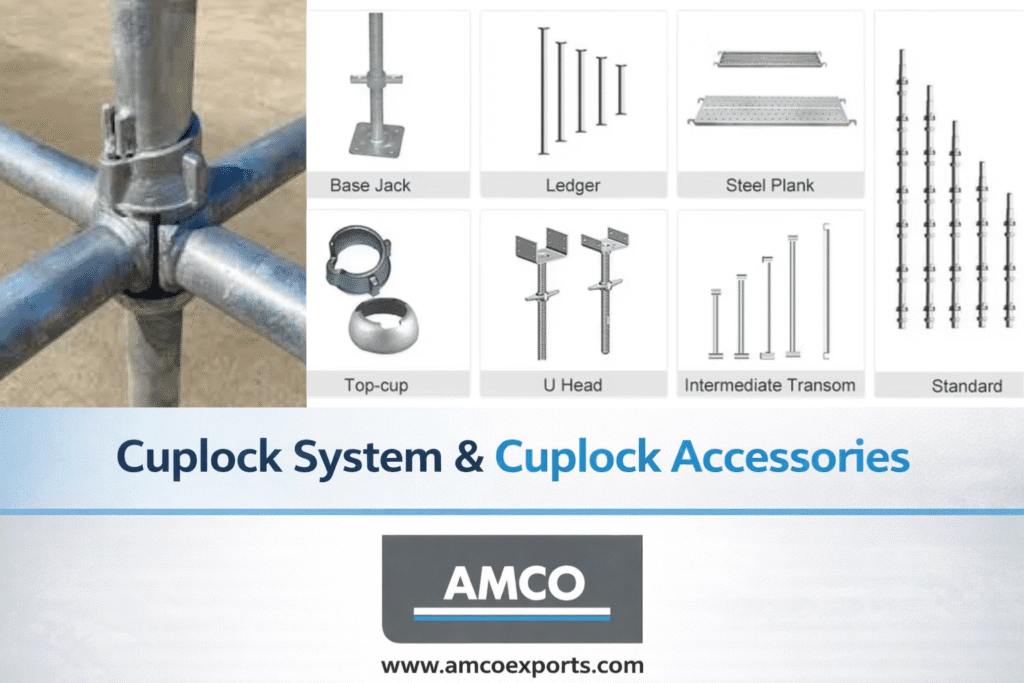
- Cuplock Vertical Standards – form the main load-bearing vertical framework
- Cuplock Intermediate Transoms – support platform decking and distribute loads
- Top Cup & Bottom Cup – lock ledgers and transoms securely at node points
- Cuplock Base Jack / Adjustable Jack – allow height adjustment and ground leveling
- Cuplock Spigot / Joint Pin – connect vertical standards in height
- Steel Planks / Scaffold Boards – create safe working platforms
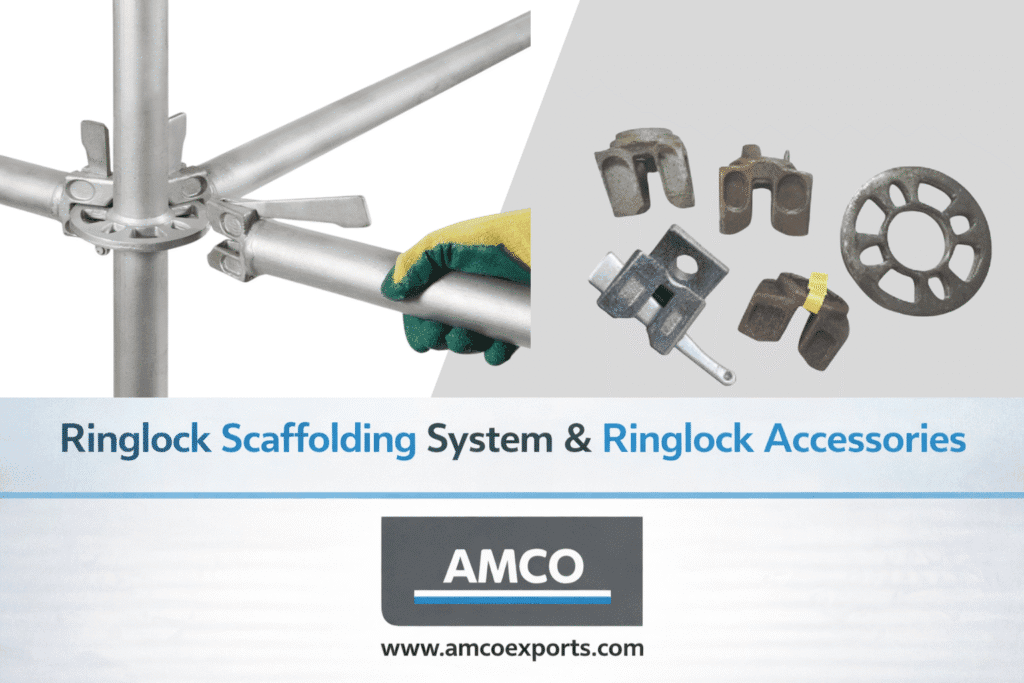
Ringlock System Components:
- Standards: Vertical tubes with welded rosettes.
- Ledgers & Braces: Use the same wedge-end connection.
- Base Jacks & Screw Jacks: For adjustment and leveling.
- Self-Locking Wedges: The key to the multi-directional node.
For detailed visuals, suppliers often provide a scaffolding parts name with pictures PDF, which is invaluable for training and procurement.
Explore Related Scaffolding Products
- Looking for complete systems? Explore our Scaffolding Systems & Components.
- Need fittings and clamps? Check our Scaffolding Couplers & Clamps range.
- For strong support and height adjustment, view Scaffolding Jacks & Props.
- Also explore Cuplock Accessories for heavy-duty modular scaffolding projects.
Cuplock vs Ringlock Scaffolding: Application-Based Selection
Your project’s specific needs should dictate your choice. Here’s a clear guide on where each excels.
Ideal Uses for the Cuplock System
This system is the champion of efficiency for standard projects.
- Building Facades & Straight Walls: Its design is optimized for right angles and repetitive bays.
- Large-Area Platforms: Quick to deploy over big footprints.
- Shoring & Support Work: Proven reliability for vertical load-bearing.
- Cost-Sensitive or Fast-Paced Projects: Lower initial cost and rapid assembly reduce time and budget pressure.
Ideal Uses for the Ringlock System
This system is the choice for complexity and heavy-duty demands.
- Industrial & Power Plants: Navigates irregular equipment and structures with ease.
- Curved or Complex Geometries: The rosette connection handles non-standard angles seamlessly.
- Heavy-Duty Support & Access Towers: Engineered for exceptional load capacity and stability.
- Long-Term or Multi-Use Projects: Its versatility offers a better return on investment across different site conditions.
Cost, Specifications & Sourcing: Cuplock vs Ringlock Scaffolding Prices
Pricing Factors and How to Get Quotes
Pricing for Cuplock accessories and Ringlock components depends on:
- Material & Finish: Hot-dipped galvanized lasts longer but costs more than painted.
- Quantity & Quality: Bulk orders from a reputable scaffolding manufacturer yield better rates.
- Location: For example, sourcing scaffolding in India may offer competitive advantages in certain regions.
To get accurate figures, always request a formal scaffolding parts price list or a project-specific quote from suppliers. Many reputable companies now offer these scaffolding accessories online.
Key Technical Documents
- Load Charts & Manuals: A scaffolding system PDF from the manufacturer is non-negotiable for safe design.
- Assembly Guides: Look for diagrams and step-by-step instructions to ensure proper erection.
Expert Comparison: Speed, Safety, and Long-Term Value
| Expert Comparison | ✅ Cuplock System | ✅ Ringlock System |
|---|---|---|
| ⚡ Erection Speed |
Best for standard sites |
Best for industrial layouts |
| 🧩 Design Flexibility | ||
| 🏗️ Typical Load Capacity | ||
| 💰 Initial Cost | ||
| ♻️ Long-Term Value | ||
| 🎓 Skill Requirement |
Making Your Decision: A Simple Checklist
Ask yourself these questions:
- Geometry: Is my project mostly straight lines or does it have curves and complex angles? (Straight = Cuplock, Complex = Ringlock)
- Budget: Am I prioritizing lowest upfront cost or long-term versatility? (Upfront = Cuplock, Long-term = Ringlock)
- Timeline: How critical is rapid erection for simple structures? (Critical = Cuplock)
- Future Use: Will I reuse this system for different types of projects? (Yes = Ringlock)
Still Unsure? Let Our Experts Guide You.
Choosing the right system impacts your project’s safety, budget, and timeline. Don’t guess—get expert analysis.
📞 Consult with a Specialist Today!
Our team provides:
- Free project analysis and system recommendation.
- Detailed quotations with component price lists.
- Technical support and certified load calculations.
Explore Related Scaffolding Products
- Looking for complete systems? Explore our Scaffolding Systems & Components.
- Need fittings and clamps? Check our Scaffolding Couplers & Clamps range.
- For strong support and height adjustment, view Scaffolding Jacks & Props.
- Also explore Cuplock Accessories for heavy-duty modular scaffolding projects.
📥 Instant Resources:
[👉 Cuplock –Download Free Comparison Chart & Spec Sheets]
👉 Ringlock –Download Free Comparison Chart & Spec Sheets]
🔧 Get a Tailored Quote:
[📩 Request Your Custom Quotation Here]
🏆 Your Trusted Partner:
- Direct distributor for major brands.
- Pan-India supply and support network.
- Genuine, certified components with warranty.
Contact Us Now:
- Call/WhatsApp: +91 98888 82322
- Email: amcosales1@gmail.com
- Website: www.amcosales.com
Follow us on Instagram : https://www.instagram.com/amcoexports/
Follow us on LinkedIn : https://www.linkedin.com/in/amcoexports/
Frequently Asked Questions (FAQ) – Cuplock vs Ringlock Scaffolding
1) What is the main difference between Cuplock and Ringlock scaffolding systems?
The main difference is the locking mechanism. Cuplock scaffolding uses a cup-and-wedge connection for fast right-angle structures, while Ringlock uses a rosette node with wedge pins for multi-directional connections and higher flexibility in complex layouts.
2) Which is better for construction projects: Cuplock scaffolding or Ringlock scaffolding?
Both are strong modular systems. Cuplock is better for straight buildings, facades, and fast erection, while Ringlock is better for industrial sites, curved geometries, and complex scaffolding designs. The best option depends on the project type and site requirements.
3) Is Ringlock scaffolding stronger than Cuplock scaffolding?
In many heavy-duty applications, Ringlock scaffolding is often engineered for higher load performance due to its rosette connection design. However, Cuplock is also highly reliable for standard construction and shoring work when installed as per manufacturer guidelines.
4) Can Cuplock and Ringlock scaffolding parts be used together?
No. Cuplock and Ringlock parts should not be mixed because they have different connection mechanisms and component geometry. Mixing systems can reduce structural integrity and create safety risks. Always use one compatible system on site.
5) Which scaffolding system is more cost-effective: Cuplock or Ringlock?
Cuplock is usually more cost-effective upfront for simple and repetitive projects. Ringlock has higher initial cost, but offers better long-term value due to flexibility, higher reuse across project types, and strong resale demand in industrial markets.