
Table of Contents
- Types of Formwork Fasteners Used in Construction
- Tie Rod as One of the Main Formwork Fasteners
- Key Functions of Tie Rod Formwork Fasteners
- Anchor Nut in Formwork Fasteners
- Wing Nut Used in Formwork Fasteners
- How These Components Work Together
- Technical Considerations in Formwork Tie Rod Systems
- Difference Between Formwork Fasteners: Tie Rod, Anchor Nut and Wing Nut
- Industrial Applications of Tie Rod Systems
- Frequently Asked Questions About Formwork Fasteners
- Conclusion
Types of Formwork Fasteners Used in Construction
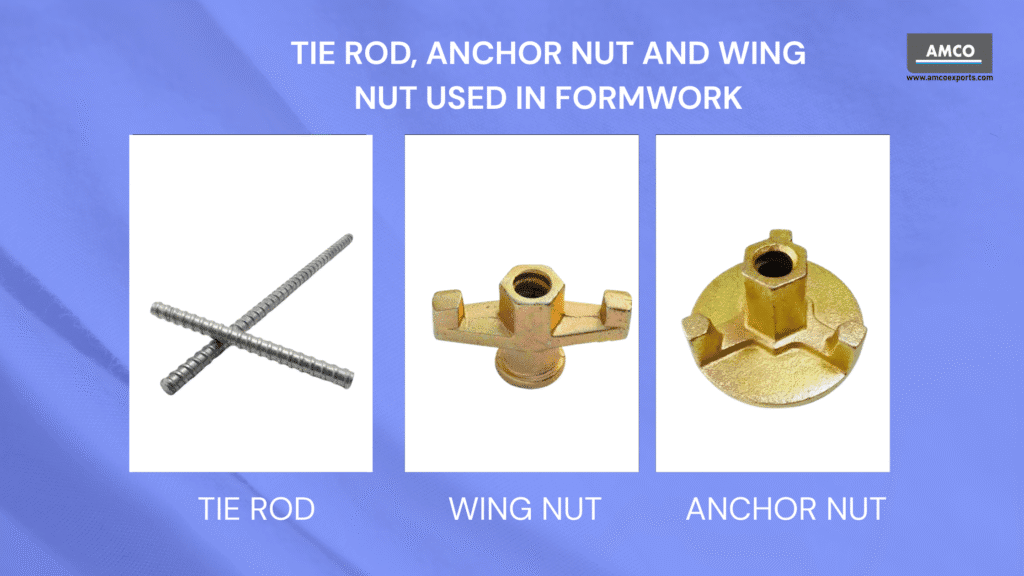
Formwork fasteners play a critical role in concrete construction. In modern formwork systems, contractors use components such as tie rods, anchor nuts and wing nuts as essential formwork fasteners to hold shuttering panels together and resist concrete pressure during casting. Therefore, understanding how these formwork fasteners work together helps contractors build stable, accurate and safe formwork structures.
Understanding the difference between these fasteners helps contractors select the right components for safe and efficient construction. A tie rod system usually works with several fasteners. Contractors commonly use a wing nut manufacturer product for quick tightening and an anchor nut for tie rod to distribute load. High-quality formwork tie rod manufacturer components ensure the formwork structure remains stable during concrete pouring.
Tie Rod as One of the Main Formwork Fasteners
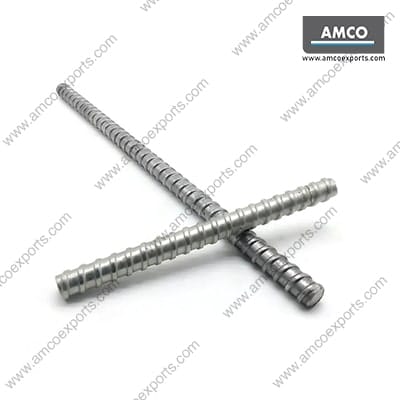
A tie rod is a threaded steel rod used in concrete formwork systems to hold two formwork panels together. It resists the lateral pressure generated when fresh concrete is poured.
Tie rods pass through the formwork panels and are tightened with nuts on both sides to maintain the desired wall thickness.High-strength formwork tie rods are essential for holding shuttering panels under heavy concrete pressure during casting.
Key Functions of Tie Rod Formwork Fasteners
• Maintain correct spacing between shuttering panels
• Resist concrete pressure during pouring
• Ensure wall alignment and structural accuracy
• Provide reusable fastening in formwork systems
Common tie rod sizes include 12mm, 16mm and 17mm depending on the load and formwork design.
Anchor Nut in Formwork Fasteners
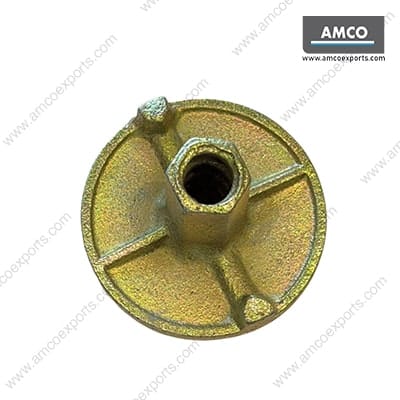
An anchor nut is used with tie rods to secure the formwork system and distribute load evenly across the formwork plate or waller plate.
Anchor nuts are designed to provide strong gripping support and prevent loosening under heavy loads. For additional load support, contractors often use an anchor nut with tie rods to distribute pressure evenly across formwork plates.
Key Features of Anchor Nuts
• High load-bearing capacity
• Wide bearing surface for stability
• Used with tie rods and waller plates
• Prevents movement of formwork panels
Anchor nuts are commonly used in large infrastructure and high-rise construction projects.
Wing Nut Used in Formwork Fasteners
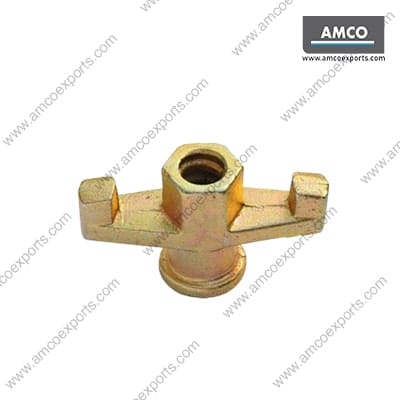
A wing nut is a fastener used with tie rods in formwork systems that allows quick tightening and removal without special tools.
The wing-shaped handles allow workers to manually tighten the nut, making installation and dismantling faster on construction sites. In many formwork systems, the tie rod is tightened using a wing nut that allows fast manual locking and removal during shuttering work.
Advantages of Wing Nuts
• Quick installation and removal
• Easy manual tightening
• Ideal for reusable formwork systems
• Saves labour time during formwork assembly
Wing nuts are widely used in scaffolding and shuttering systems.
Difference Between Formwork Fasteners: Tie Rod, Anchor Nut and Wing Nut
| Component | Function | Location | Key Benefit |
|---|---|---|---|
| Tie Rod | Holds formwork panels together | Runs through formwork | Resists concrete pressure |
| Anchor Nut | Locks tie rod in position | Outside formwork | Provides load support |
| Wing Nut | Tightens tie rod manually | End of tie rod | Quick installation |
These three components work together to create a stable and secure formwork fastening system. In practical construction projects, these components are used together as a complete fastening system.
Contractors typically rely on a wing nut manufacturer product for quick tightening of tie rods, while an anchor nut for tie rod helps distribute load evenly across the formwork plate. High-strength components from a reliable formwork tie rod manufacturer ensure the formwork structure remains stable during concrete pouring and prevent movement under concrete pressure.
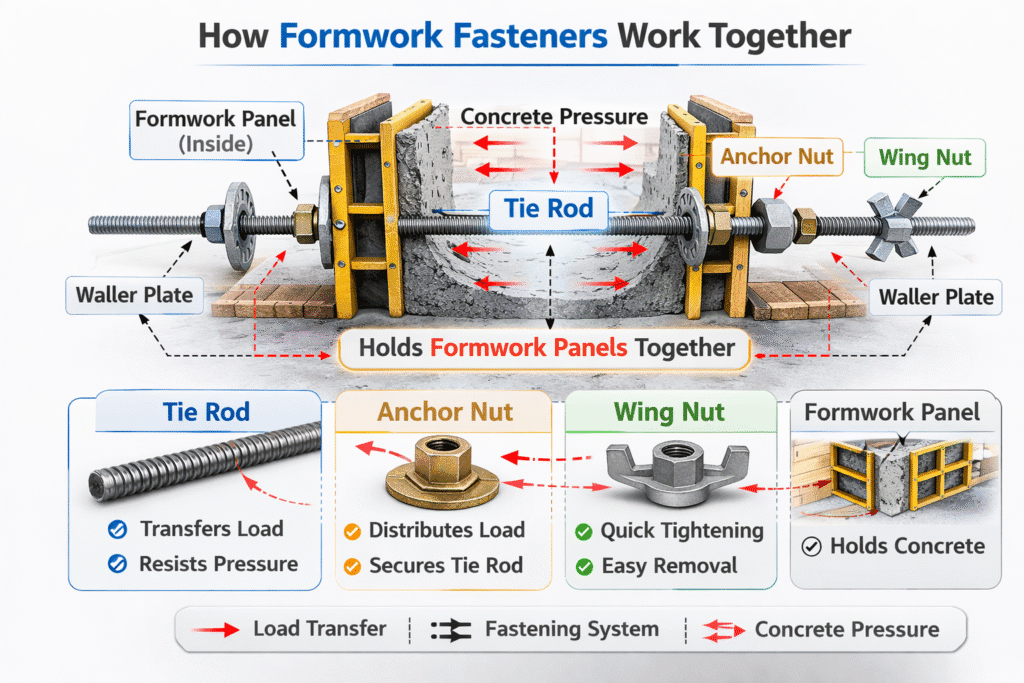
How These Components Work Together
In a typical formwork setup:
- The tie rod passes through the formwork panels.
- The anchor nut distributes load and secures the tie rod.
- The wing nut is tightened to lock the system in place.
This combination ensures that the formwork structure can safely withstand high concrete pressure during casting. These formwork fasteners are designed to secure shuttering panels and maintain the correct wall thickness during concrete pouring.
Technical Considerations in Formwork Tie Rod Systems
In concrete construction, tie rod systems help control the lateral pressure created by freshly poured concrete. As the wall height increases and the pouring rate rises, the pressure on formwork panels also increases. Therefore, contractors must use strong and reliable formwork fasteners to maintain structural stability during casting.
Manufacturers typically produce tie rods from high-tensile steel with precise threading to ensure uniform load transfer across the formwork system. When workers pour concrete into the shuttering, the pressure pushes outward on the formwork panels. The tie rod transfers this force through the system and keeps the panels aligned.
Several technical factors influence the performance of tie rod systems.
Concrete Pressure Resistance
First, tie rods must withstand the lateral pressure generated by wet concrete. This pressure can reach several kilonewtons per square meter depending on wall height, concrete density and pouring speed.
Thread Accuracy
In addition, precise threading allows anchor nuts and wing nuts to engage securely with the tie rod. Accurate threads prevent slippage and ensure tight fastening during formwork assembly.
Load Distribution
Similarly, anchor nuts and waller plates distribute the load evenly across the formwork panel surface. This distribution reduces stress concentration and helps prevent panel damage or deformation.
Material Strength
Finally, high-strength steel improves durability and allows workers to reuse the fasteners across multiple construction cycles.
As a result, selecting high-quality tie rods, anchor nuts and wing nuts helps maintain formwork stability, accurate wall dimensions and safer construction operations.
Industrial Applications of Tie Rod Systems
Tie rod fastening systems are widely used in:
• High-rise buildings
• Bridge construction
• Infrastructure projects
• Industrial concrete structures
• Basement and retaining wall construction
These components are essential in any project where concrete formwork stability is critical. Selecting high-quality formwork fasteners ensures the formwork system remains stable and reusable across multiple construction cycles. These applications rely heavily on durable formwork fasteners to maintain formwork stability during concrete pouring.
Formwork Fastener Manufacturer in India
AMCO Exports manufactures high-quality formwork fasteners including tie rods, wing nuts, anchor nuts, and other scaffolding accessories used in construction and infrastructure projects.
The company supplies durable components designed to withstand heavy loads in formwork systems and provides supply across Pan-India and export markets.
Conclusion
Tie rods, anchor nuts and wing nuts play different but equally important roles in formwork systems. Together these formwork fasteners create a strong fastening system capable of resisting concrete pressure and maintaining structural accuracy during construction.
Selecting high-quality components ensures safety, durability, and efficiency on construction sites.
In modern construction, a strong fastening system is essential for safe and efficient formwork installation.
Using high-quality components such as tie rods, anchor nuts, and wing nuts ensures the structure can withstand heavy concrete pressure. contractors often source these Formwork Fasteners from a trusted formwork tie rod manufacturer, along with reliable anchor nut for tie rod and wing nut manufacturer products to ensure durability and consistent performance on construction sites.
To understand the complete working principle, read our detailed guide on tie rod in formwork systems.
Stay connected for product updates and site-use insights:
Instagram: https://www.instagram.com/amcoexports
LinkedIn: https://www.linkedin.com/in/amcoexports/
Frequently Asked Questions About Formwork Fasteners
What are formwork fasteners in concrete construction?
Formwork fasteners are components used to hold formwork panels together during concrete casting. Common formwork fasteners include tie rods, anchor nuts, and wing nuts, which work together to resist concrete pressure and maintain the correct wall thickness.
What is the role of a tie rod in formwork systems?
A tie rod is a threaded steel rod used in formwork systems to connect opposite panels and resist the lateral pressure created by fresh concrete. It keeps the panels aligned and prevents them from moving during pouring.
Why are anchor nuts used with tie rods?
Anchor nuts secure the tie rod and help distribute the load evenly across the formwork plate or waller plate. This prevents damage to the formwork panels and improves overall structural stability during casting.
What is the purpose of a wing nut in formwork?
A wing nut allows workers to tighten and remove the fastening system quickly without special tools. Its wing-shaped handles make manual tightening easy, which helps speed up formwork assembly and dismantling.
What materials are used to manufacture formwork fasteners?
Most formwork fasteners such as tie rods, anchor nuts, and wing nuts are manufactured from high-strength steel. This ensures durability, high load-bearing capacity, and the ability to reuse the components across multiple construction cycles.