
Scaffolding systems used in Indian construction play a critical role in modern infrastructure projects. From high-rise buildings to bridges and industrial plants, contractors rely on strong scaffolding structures to maintain safety, efficiency, and structural alignment during construction
Table of Contents
- Scaffolding Systems Used in Indian Construction
- Types of Scaffolding Systems Used in Indian Construction
- Cuplock Scaffolding System Used in Indian Construction
- Ringlock Scaffolding System Used in Infrastructure Projects
- Traditional Scaffolding Systems Used in Indian Construction
- Compare Scaffolding Systems Used in Indian Construction
- Why Modular Scaffolding Systems Are Popular in Indian Construction
- Choosing the Right Scaffolding System for Your Project
- Frequently Asked Questions
Behind every large construction project is a support system that rarely gets attention but plays a critical role in safety and efficiency scaffolding.
Scaffolding provides temporary structural support that allows workers to access heights, handle materials, and maintain alignment during construction. The system chosen for a project affects everything from installation speed to labour costs and site safety.
Today, Indian construction projects typically use three main scaffolding systems:
Each system has its own advantages depending on the project scale, structure complexity, and load requirements.
In this guide, we compare these scaffolding systems and explain how contractors choose the right one for modern infrastructure projects.
Scaffolding Systems Used in Indian Construction Projects
Scaffolding systems serve multiple functions on a construction site. They provide safe working platforms, structural support during slab casting, and stable frameworks for workers operating at height.
Without a properly designed scaffolding system, construction sites face several risks:
• Worker safety hazards
• Structural instability during construction
• Slower work progress
• Increased labour costs
Because of this, large contractors often work with experienced scaffolding manufacturers and suppliers who maintain consistent product quality.
Modern scaffolding systems have evolved to improve assembly speed, structural stability, and overall efficiency.
Compare Scaffolding Systems Used in Indian Construction
Before comparing the systems, it is important to understand the basic design principles of each type.
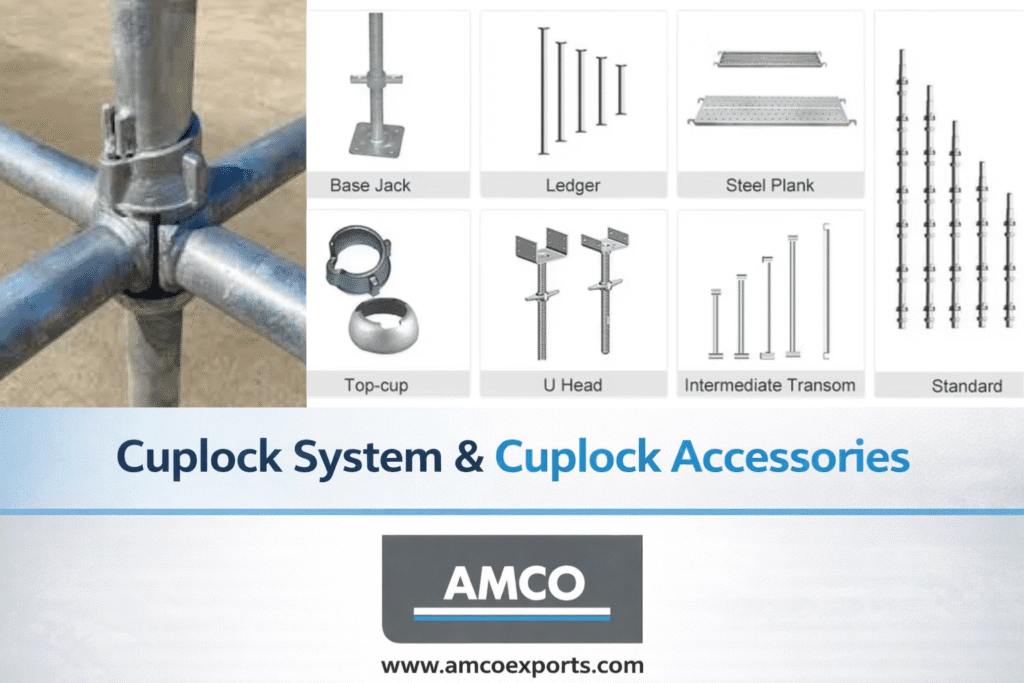
Cuplock Scaffolding System Used in Indian Construction
Cuplock scaffolding is one of the most widely used modular scaffolding systems in India. It features a unique cup and blade locking mechanism that allows horizontal and vertical members to connect quickly without loose fittings.
The simplicity of the locking system makes installation faster while maintaining strong structural support.
Cuplock systems are commonly used in:
- High-rise buildings
- Bridges and flyovers
- Industrial plants
- Infrastructure construction projects
Because of their high load-bearing capacity, cuplock scaffolding systems are preferred for large construction environments.
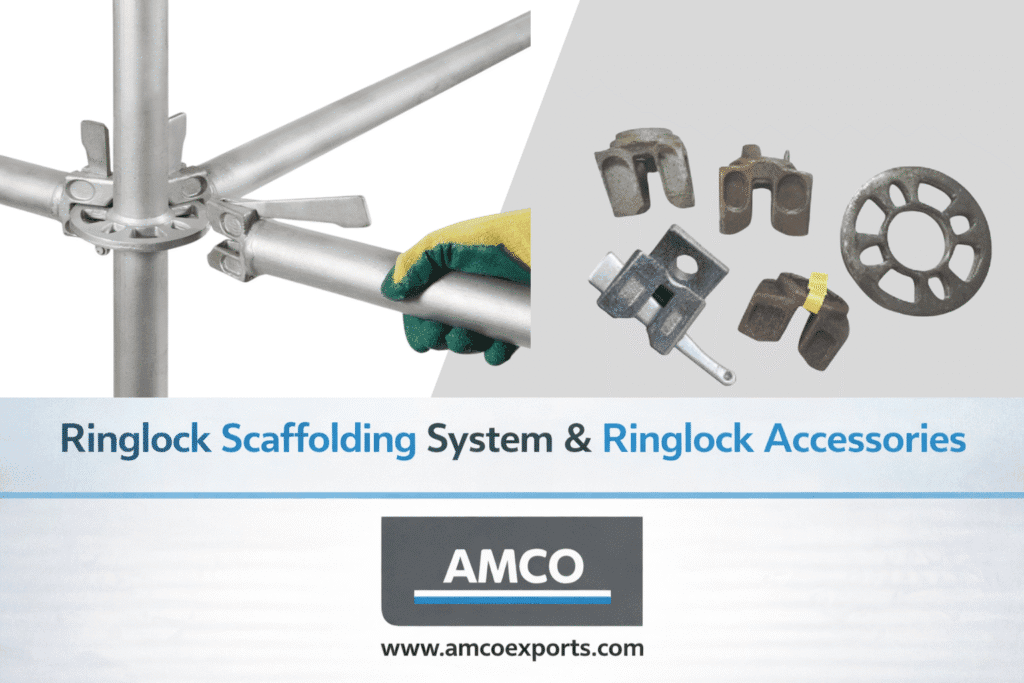
Ringlock Scaffolding System Used in Infrastructure Projects
Ringlock scaffolding is another modular system that uses a rosette-style locking connection.
Vertical standards feature circular rosettes that allow multiple components to connect at different angles. This makes ringlock scaffolding extremely versatile.
Ringlock systems are commonly used in:
- Complex structural projects
- Infrastructure with irregular layouts
- Oil and gas construction sites
- Heavy industrial projects
While ringlock scaffolding offers flexibility, it typically requires slightly higher investment compared to other systems.
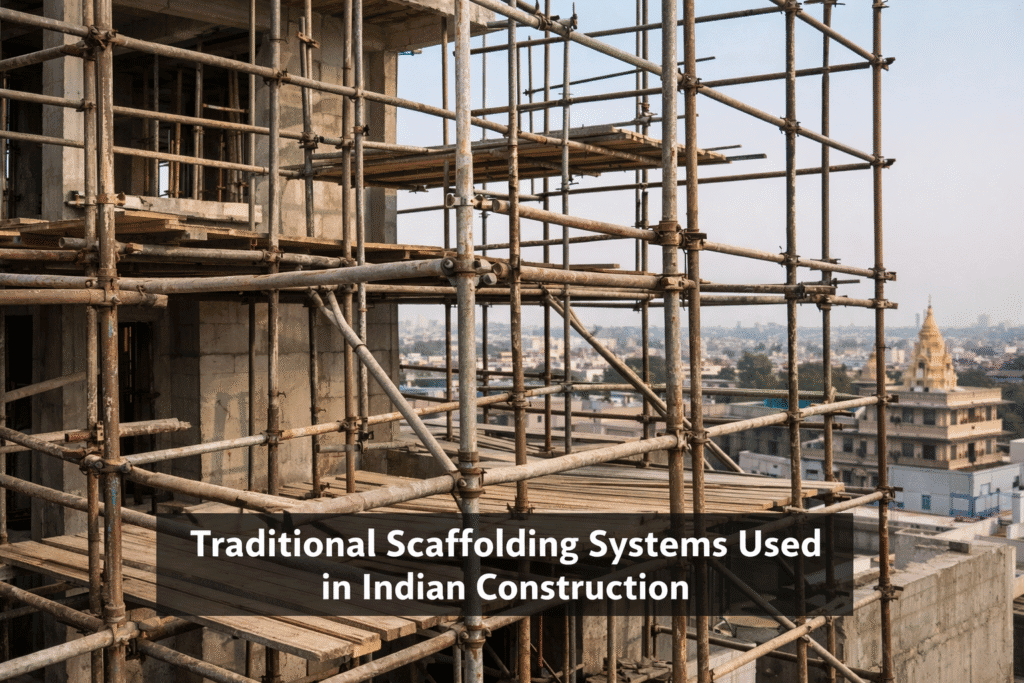
Traditional Scaffolding Systems Used in Indian Construction
Before modular scaffolding systems became popular, traditional pipe scaffolding was the standard in construction.
This system uses steel pipes connected with clamps and couplers. Although it offers flexibility, it requires more time and labour to assemble.
Traditional scaffolding is still used in:
- Small residential projects
- Temporary maintenance structures
- Renovation work
However, due to slower assembly and lower structural stability compared to modular systems, many large contractors now prefer modern scaffolding solutions.
Comparison of Scaffolding Systems Used in Indian Construction
| Feature | Cuplock | Ringlock | Traditional |
|---|---|---|---|
| Assembly Speed | Fast locking with cup joint system | Very fast modular connection | Slow manual assembly |
| Structural Stability | High stability for vertical structures | Very high stability for complex structures | Moderate stability |
| Load Capacity | High load-bearing capacity | Extremely high load capacity | Limited load capacity |
| Labor Requirement | Moderate labour requirement | Low labour requirement | High labour requirement |
| Installation Complexity | Simple and efficient | Flexible but slightly complex | Labour intensive |
| Project Suitability | High-rise and infrastructure projects | Complex engineering structures | Small construction projects |
| Cost Efficiency | Cost-effective for large projects | Higher initial investment | Lower initial cost |
Choosing the Right Scaffolding System Based on Project Type
Different construction environments require different scaffolding solutions.
Best Scaffolding for High-Rise Construction
High-rise buildings require scaffolding systems that provide strong vertical support and fast installation.
Cuplock scaffolding is commonly preferred because its cup locking system allows quick assembly while maintaining high load capacity.
Best Scaffolding for Complex Structures
Large infrastructure projects often involve irregular designs and multiple connection points.
Ringlock scaffolding systems offer greater flexibility in such cases because components can connect at different angles using rosette connectors.
Best Scaffolding for Small Construction Projects
Small residential projects often rely on traditional pipe scaffolding due to its lower initial cost and flexibility.
However, these systems require more labour and time during installation.
Why Modular Scaffolding Systems Are Popular in Indian Construction
Over the last decade, the Indian construction industry has shifted significantly toward modular scaffolding systems such as cuplock and ringlock.
The main reasons include:
Faster Installation
Modular systems allow workers to assemble scaffolding much faster than traditional pipe scaffolding.
Reduced Labour Requirements
Because the components lock together quickly, fewer workers are required to assemble the system.
Improved Structural Stability
Modern scaffolding systems are designed to distribute loads evenly, improving safety during construction.
Better Dimensional Accuracy
Manufactured components ensure consistency across multiple installations.
These advantages make modular scaffolding systems ideal for large infrastructure projects.
Importance of Quality Manufacturing in Scaffolding
The reliability of scaffolding systems depends heavily on manufacturing precision.
Small variations in components such as tie rods, base jacks, and wing nuts can cause alignment issues during construction.
Quality manufacturing ensures:
- Accurate threading
- Strong casting quality
- Consistent dimensional tolerance
- Reliable load performance
Contractors often prefer working with established scaffolding manufacturers that maintain controlled production systems and strict inspection standards.
Companies like AMCO Exports, operating since 1989, manufacture scaffolding accessories and formwork hardware used across infrastructure and construction projects.
Their product range includes:
Such components form the structural backbone of many construction projects
The Future of Scaffolding Systems in India
India’s infrastructure growth is expected to continue over the next decade with new transportation corridors, renewable energy projects, and urban development.
As construction technology advances, scaffolding systems will continue evolving to improve safety and efficiency.
Contractors are increasingly focusing on:
- Modular scaffolding solutions
- High-strength materials
- Faster assembly systems
- Reliable manufacturing sources
Choosing the right scaffolding system will remain a critical factor in project success.
Conclusion
Scaffolding systems are essential components of modern construction. The type of scaffolding chosen can affect project timelines, safety standards, and overall efficiency.
Cuplock scaffolding is ideal for high-rise and infrastructure projects.
Ringlock scaffolding offers flexibility for complex structures.
Traditional scaffolding remains suitable for smaller construction sites.
As the construction sector grows, modular scaffolding systems will continue to dominate large projects due to their speed, safety, and structural reliability.
Contractors who carefully evaluate scaffolding systems and suppliers can significantly improve project performance and long-term efficiency.
Call to Action
If you are sourcing scaffolding components for construction or infrastructure projects, working with experienced manufacturers ensures better quality control and reliable supply.
Learn more about scaffolding manufacturing and bulk supply:
https://www.amcoexports.com
For more updates on scaffolding systems, construction trends, and manufacturing insights, you can also follow AMCO Exports on social media.
Pinterest: https://in.pinterest.com/amcoexports/
X (Twitter): https://x.com/AmcoExports
These platforms regularly share updates related to scaffolding accessories, construction hardware, and industry developments.
Frequently Asked Questions
What are the main scaffolding systems used in Indian construction?
The most common scaffolding systems used in Indian construction are cuplock scaffolding, ringlock scaffolding, and traditional pipe scaffolding. These systems provide temporary structural support and safe working platforms for workers during building and infrastructure projects.
Which scaffolding system is best for high-rise construction?
Cuplock scaffolding systems are widely used for high-rise construction projects because they offer strong load-bearing capacity, quick installation, and reliable locking mechanisms.
What is the difference between cuplock and ringlock scaffolding?
Cuplock scaffolding uses a cup-and-blade locking mechanism for quick assembly, while ringlock scaffolding uses rosette connections that allow multiple angles and connections. Ringlock systems are often preferred for complex structural projects.
Why are modular scaffolding systems popular in modern construction?
Modular scaffolding systems such as cuplock and ringlock are popular because they improve safety, reduce labor requirements, and allow faster installation compared to traditional scaffolding systems.
Where can contractors source scaffolding systems in India?
Contractors typically source scaffolding systems from experienced manufacturers and suppliers who provide consistent quality, accurate dimensions, and reliable bulk supply for construction and infrastructure projects.