
Coupler load capacity is an important factor when selecting
scaffolding couplers
for construction, maintenance and infrastructure projects. The capacity of a
coupler affects how securely scaffold tubes connect and how the connection
performs under the forces applied to the scaffold.
If you are searching for scaffolding clamp load capacity,
scaffolding fix clamp capacity,
scaffolding single clamp capacity,
right angle coupler load capacity in kg or general
scaffolding load capacity, this guide explains the key factors
you need to consider before selecting a coupler.
Different types of scaffolding couplers serve different purposes.
Right angle couplers
,
swivel couplers
,
sleeve couplers
,
putlog couplers and beam or girder couplers have different designs and
applications. Their actual resistance depends on the product specification,
tube size, connection arrangement, installation and applicable standard.
Important: Coupler capacity should never be treated as the complete
load capacity of a scaffold. The scaffold design, tubes, connections, base support,
bracing, platforms, installation and overall load path must also meet the applicable
requirements.
For a complete overview, see our
types of scaffolding couplers
guide. You can also explore our
scaffolding parts and accessories list
for related components used in scaffold systems.
Contents
- Why Coupler Load Capacity Matters
- Load Capacity of Common Scaffolding Couplers
- Scaffolding Fix Clamp Capacity
- Scaffolding Single Clamp Capacity
- Right Angle Coupler Load Capacity
- Factors Affecting Coupler Load Capacity
- How to Choose the Right Coupler Capacity
- Common Scaffolding Load Capacity Mistakes
- Coupler Capacity vs Real Site Performance
- Scaffolding Load and Safety
- How to Buy Scaffolding Couplers
- Frequently Asked Questions
Why Coupler Load Capacity Matters in Scaffolding
Every tube-and-coupler scaffold depends on its connections. A scaffold may contain strong
steel tubes, but weak, damaged or incorrectly installed connections can reduce the performance
of the entire structure.
Coupler load capacity describes the resistance of a particular coupler
under specified loading and test conditions. It should be considered together with the
scaffold design and the loads transferred through the connection.
In practical construction, the connection can experience vertical loads, horizontal forces,
movement, vibration and forces created by bracing or uneven loading. The coupler must therefore
match the intended application.
Common factors that can reduce connection performance include:
- Loading beyond the product’s rated or tested capacity
- Incorrect coupler selection
- Improper tightening
- Incorrect tube alignment
- Damaged or worn components
- Corrosion or excessive rust
- Uneven load distribution
- Incorrect scaffold assembly
Understanding these factors helps contractors and procurement teams select the appropriate
component instead of comparing products only by price.
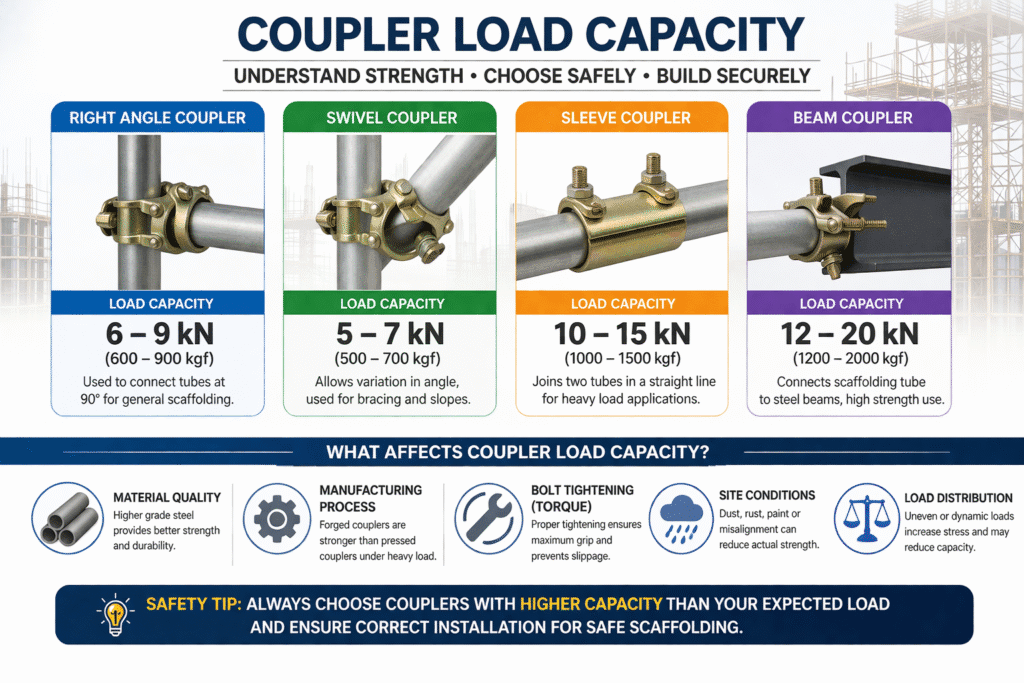
Load Capacity of Common Scaffolding Couplers
Different couplers are designed for different connection requirements. You should not assume
that every coupler of the same general type has exactly the same capacity.
| Coupler Type | Typical Application | Capacity Consideration |
|---|---|---|
| Right Angle / Double Coupler | 90° tube connections | Check tested resistance and applicable standard |
| Swivel Coupler | Diagonal and angular connections | Depends on design, strength class and installation |
| Sleeve Coupler | End-to-end tube connection | Check slip and connection resistance |
| Beam / Girder Coupler | Suitable beam or girder connections | Depends on product design and application |
The figures sometimes quoted online for coupler load capacity are not universal values.
Always confirm the manufacturer’s tested or rated value for the specific product you intend
to purchase.
You can also compare
right angle vs swivel couplers
to understand where each type is normally used.
Scaffolding Fix Clamp Capacity
Scaffolding fix clamp capacity is a common search among contractors
looking for the load resistance of fixed or right-angle scaffold connections.
A fix clamp generally connects compatible scaffold tubes at a fixed angle, commonly
approximately 90 degrees.
The actual capacity depends on the specific coupler design, tube diameter, material,
bolt and nut arrangement, tightening method, connection condition and applicable product
standard.
Therefore, a generic statement such as “one fix clamp can support X kg” can be misleading.
For a project requiring a specific load rating, use the tested value supplied for the exact
coupler model.
For a 48.3 mm scaffold tube connection, for example, the buyer should confirm that the
coupler is designed for the required tube diameter before considering its capacity.
Scaffolding Single Clamp Capacity
Scaffolding single clamp capacity depends on the type of single clamp,
its intended application and the connection configuration. A single or putlog-type clamp
should not automatically be treated as equivalent to a right angle double coupler.
Before selecting a single clamp, check:
- Tube diameter compatibility
- Product design and manufacturing method
- Material and finish
- Bolt and nut specification
- Intended direction of loading
- Manufacturer’s tested or rated resistance
- Applicable scaffold standard
This is particularly important when a connection forms part of a working platform or carries
loads transferred from scaffold members.
Right Angle Coupler Load Capacity in kg
Right angle coupler load capacity in kg is a frequent search because buyers
often want to convert a coupler rating into a simple weight figure.
However, structural resistance is commonly specified in units such as kN,
not simply kilograms. A kN value represents force, while kilograms describe mass. Converting
between them without understanding the loading condition can give a misleading impression
of the actual safe capacity.
For procurement, the better approach is to ask the supplier for the coupler’s
tested or rated resistance, applicable strength class, test standard and intended
loading direction.
For example, a right angle coupler may be suitable for connecting a ledger to a standard,
but that does not mean the coupler rating alone determines how much the complete scaffold
can safely carry.
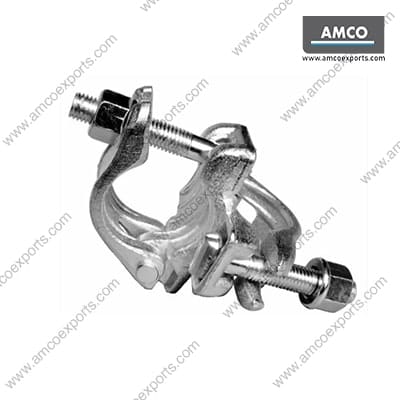
AMCO Exports supplies
drop forged right angle couplers
for compatible tube-and-coupler scaffolding applications.
Factors Affecting Scaffolding Clamp Load Capacity
Scaffolding clamp load capacity does not depend on the clamp shape alone.
Several factors influence how a connection performs in practice.
1. Material Quality
The material and mechanical properties of the coupler affect its strength and durability.
Buyers should request the relevant material specification when the project requires controlled
mechanical performance.
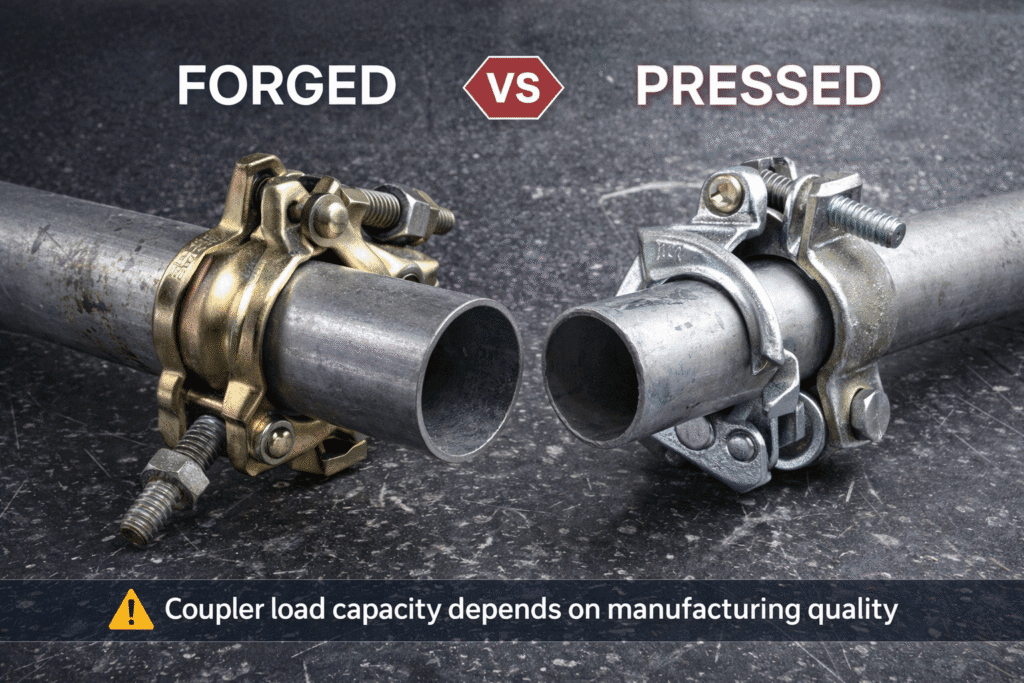
2. Manufacturing Process
The manufacturing process also matters. Depending on the application and specification,
buyers may select forged or pressed couplers.
A forged coupler and a pressed coupler should not be compared only by appearance or price.
Compare their actual specifications, intended use and tested performance.
Read our guide to
forged vs pressed couplers
for a more detailed comparison.
3. Bolt Tightening and Installation
Correct tightening is essential for maintaining the required grip between the coupler and
scaffold tube. A loose connection can slip, while incorrect installation can prevent the
coupler from achieving its intended performance.
4. Tube Diameter and Condition
The coupler must match the tube diameter for which it was designed. Tubes should also remain
in suitable condition and should not have excessive deformation, damage or corrosion at the
connection point.
5. Load Direction
A coupler may experience different forces depending on where it sits in the scaffold.
Vertical loading, horizontal forces and diagonal bracing can produce different connection
conditions.
6. Scaffold Configuration
The capacity of an individual connection does not equal the capacity of the complete scaffold.
The scaffold design must account for standards, ledgers, transoms, bracing, base support,
platform loads and other structural elements.
How to Choose the Right Coupler Load Capacity
Selecting the right coupler load capacity starts with understanding the
actual application rather than simply choosing the highest number available.
For Light-Duty Applications
Maintenance and temporary applications may require different coupler specifications from
heavy infrastructure work. Select a product that meets the actual project requirements and
applicable standard.
For General Construction
General building construction typically uses standard tube-and-coupler connections.
Confirm the tube diameter, coupler type, required strength and installation requirements.
For Heavy-Duty and Infrastructure Projects
Heavy-duty applications require greater attention to connection resistance, scaffold design,
bracing and load distribution. Use products with appropriate tested or rated performance
and follow the project engineer’s specifications.
Do not select a coupler based only on a generic capacity number found online.
The correct selection should come from the complete scaffold design and the manufacturer’s
technical information.
Common Mistakes That Reduce Scaffolding Load Capacity
Many scaffolding problems occur because the connection is not used under the conditions for
which it was designed.
- Using the wrong coupler for the connection
- Ignoring the manufacturer’s rated capacity
- Assuming all 48.3 mm couplers have identical strength
- Using damaged or heavily corroded couplers
- Incorrectly tightening bolts
- Loading the scaffold unevenly
- Ignoring bracing requirements
- Using a coupler outside its intended loading direction
- Assuming coupler capacity equals total scaffold capacity
- Choosing products only because they are cheaper
Avoiding these mistakes improves connection reliability and helps procurement teams select
products according to the actual project requirement.
Coupler Load Capacity vs Real Site Performance
On paper, a coupler may have a defined test or rated resistance. On a construction site,
actual performance can also depend on installation, alignment, tube condition, load
distribution and environmental conditions.
This means a high-capacity coupler cannot compensate for an incorrectly designed or poorly
assembled scaffold.
For this reason, contractors should consider both coupler load capacity
and the complete scaffold load path.
The manufacturing process can also influence the product specification. See our
forged vs pressed couplers
guide for additional information.
Scaffolding Load Capacity and Safety
Scaffolding load capacity refers to the capacity of the scaffold system
as a whole, not simply the capacity of one coupler.
The overall assessment can involve:
- Scaffold tube strength
- Coupler resistance
- Standard and ledger arrangement
- Bracing
- Base support
- Platform construction
- Intended working load
- Wind and environmental conditions
- Scaffold height and configuration
- Installation and inspection
For U.S. projects, OSHA’s scaffold requirements state that scaffolds and scaffold components
must not be loaded beyond their maximum intended loads or rated capacities. See the official
OSHA 29 CFR 1926.451 – General Requirements for Scaffolds
for applicable requirements.
Always follow the regulations, standards, engineering design and manufacturer’s instructions
that apply to your project location.
Scaffolding Couplers for Different Applications
AMCO Exports supplies different scaffolding coupler types for construction and infrastructure
applications. The appropriate product depends on the connection required.
-
Right Angle / Double Coupler
– for compatible 90-degree tube connections. -
Swivel Coupler
– for angular and diagonal connections. -
Sleeve Coupler
– for compatible end-to-end tube connections. -
Putlog Coupler
– for suitable putlog and platform connections. -
Girder Coupler
– for compatible beam and girder applications.
How to Buy Scaffolding Couplers in Bulk
If you are purchasing couplers for a project, send the supplier the following information:
- Coupler type
- Tube diameter
- Required quantity
- Material or manufacturing specification
- Surface finish
- Applicable standard
- Required testing or inspection documents
- Packing requirements
- Delivery location
This information helps the supplier provide a more accurate quotation and prevents
specification mismatches during procurement.
Need Scaffolding Couplers for Your Project?
Send your coupler type, tube size, quantity and project requirement
for a quotation.
Right Angle | Swivel | Sleeve | Putlog | Girder Couplers
GET COUPLER QUOTATION ON WHATSAPP
Call / WhatsApp: +91 98888 82322
Email: amcosales1@gmail.com
Final Thoughts on Coupler Load Capacity
Coupler load capacity should be treated as one part of the overall scaffold
design rather than as a standalone safety number.
The right selection considers the coupler type, tube diameter, connection direction, product
specification, tested resistance, installation method and the loads expected on the scaffold.
For contractors searching for scaffolding clamp capacity,
scaffolding fix clamp capacity, single clamp capacity
or right angle coupler load capacity, the most reliable approach is to
verify the exact product specification instead of relying on generic internet values.
If you need help selecting a coupler for your project, send us your application, tube size,
load requirement and quantity. Our team can help you identify the appropriate product for
your procurement requirement.
Frequently Asked Questions About Coupler Load Capacity
What is coupler load capacity?
Coupler load capacity refers to the resistance of a particular scaffolding coupler under
specified loading and test conditions. The applicable value depends on the coupler design,
strength class, connection arrangement, installation and relevant standard.
What is scaffolding clamp load capacity?
Scaffolding clamp load capacity is the resistance of a specific clamp or coupler under
specified conditions. It should not be treated as the total load capacity of the scaffold.
What is scaffolding fix clamp capacity?
Scaffolding fix clamp capacity depends on the specific fixed or right-angle coupler,
tube diameter, material, connection design, installation and applicable testing requirements.
Always check the manufacturer’s tested or rated value.
What is scaffolding single clamp capacity?
Scaffolding single clamp capacity varies according to the clamp type, product design,
tube size, loading direction and application. A single clamp should be selected according
to its intended use and technical specification.
What is the right angle coupler load capacity in kg?
Right angle coupler resistance is commonly expressed as force, such as kN, rather than
simply kilograms. The exact capacity depends on the specific product and test conditions.
For procurement, ask for the manufacturer’s tested or rated resistance and applicable standard.
Which scaffolding coupler has the highest load capacity?
There is no universal answer because coupler resistance depends on the product design,
strength class and loading condition. Sleeve, beam and other specialised couplers may have
different resistance characteristics from right-angle or swivel couplers.
Can coupler capacity change on site?
Yes. Installation, bolt tightening, tube alignment, tube condition, corrosion and load
distribution can affect the actual performance of a connection.
Are forged couplers suitable for heavy-duty scaffolding?
Forged couplers are commonly selected for demanding applications, but suitability should
always be confirmed against the product specification, tested performance, applicable
standard and scaffold design.
How do I choose the right coupler capacity?
Start with the scaffold design and intended loading. Then confirm the tube diameter,
coupler type, manufacturer’s rated or tested resistance, applicable standard and installation
requirements. The coupler rating should be considered as part of the complete scaffold design.
What is scaffolding load capacity?
Scaffolding load capacity refers to the capacity of the complete scaffold system. It depends
on the tubes, connections, bracing, base support, platforms, configuration and intended loads,
not simply on the capacity of one coupler.
Explore the complete
AMCO Exports scaffolding coupler range
for different construction and infrastructure applications.
Instagram:
AMCO Exports
LinkedIn:
AMCO Exports