
Scaffolding coupler load capacity is an important consideration when selecting tube-and-coupler scaffolding components for construction, infrastructure and industrial projects. Contractors need to understand how coupler type, tube dimensions, tightening, installation and the overall scaffold design affect connection performance.
AMCO Exports manufactures and supplies scaffolding couplers for construction and industrial applications. This guide explains the difference between coupler types, answers common load-capacity enquiries and outlines the information buyers should confirm before selecting a product.
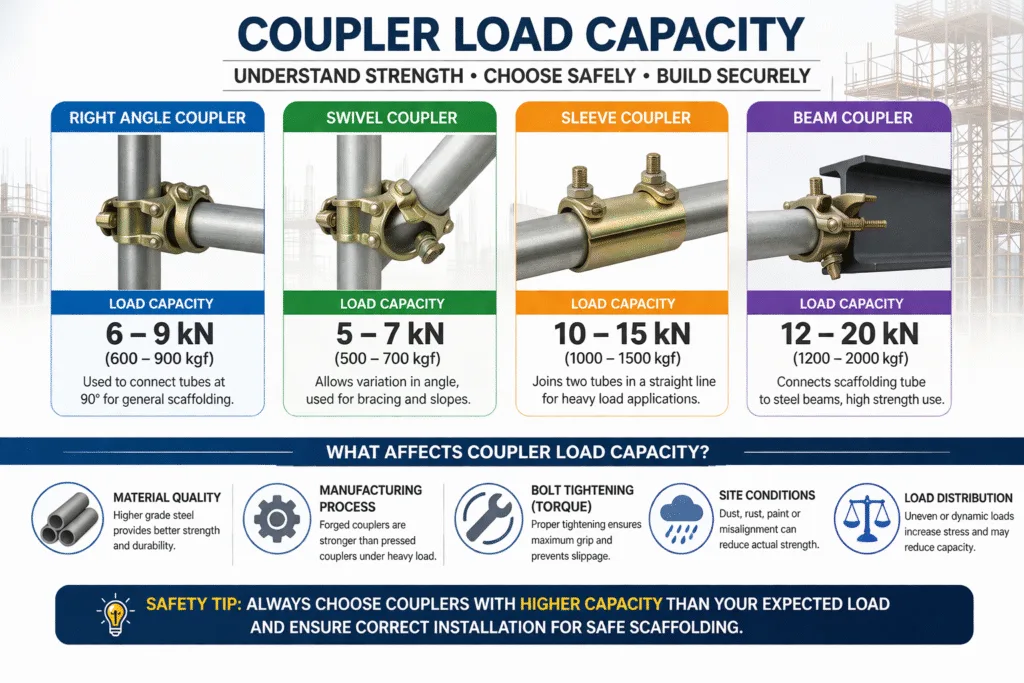
Important safety note: A coupler’s load rating must come from applicable product documentation or test evidence. Do not treat a general online estimate as an approved working load for a scaffold. The complete scaffold design and site conditions also determine safe use.
What Is Scaffolding Coupler Load Capacity?
Scaffolding coupler load capacity describes the resistance of a coupler connection to forces acting on it under defined test or design conditions. The relevant value depends on the type of connection and the way the manufacturer or applicable standard defines and tests its performance.
Buyers should distinguish between slip resistance, tensile resistance, rotational resistance and other connection properties. These values describe different behaviours and are not interchangeable. A test result for one property does not automatically establish the safe working load of an entire scaffold.
Types of Scaffolding Couplers and Their Applications
Different couplers perform different connection functions. Use the table below to identify the connection type before requesting its verified load rating.
| Coupler Type | Connection Function | What to Verify |
|---|---|---|
| Right-Angle / Double Coupler | Connects compatible scaffold tubes at a fixed 90-degree angle. | Slip resistance, tube compatibility, tightening requirements and applicable test documentation. |
| Swivel Coupler | Connects compatible tubes at adjustable angles, commonly for diagonal bracing. | Relevant resistance ratings, tube sizes, bolt specification and test conditions. |
| Sleeve Coupler | Joins compatible tube ends in an end-to-end connection. | Axial connection performance, tube alignment and the manufacturer’s approved application. |
| Putlog Coupler | Supports a compatible putlog or transom connection in the intended scaffold arrangement. | Specified use, connection arrangement and product test data. |
| Beam or Girder Coupler | Connects compatible scaffold components to a suitable structural beam or flange, where the product is designed for that purpose. | Approved flange range, loading direction, connection ratings and installation instructions. |
| RAC / Fixed Coupler | Provides a fixed connection in a compatible tube arrangement. | Exact model, tube sizes, fastening arrangement and supporting technical data. |
Explore the AMCO Exports scaffolding couplers and clamps range to compare available product types.
Scaffolding Coupler Load Capacity: What the Numbers Mean
Searches such as “scaffolding clamp capacity,” “double coupler capacity,” “right angle coupler load capacity in kg” and “scaffolding clamp load capacity in kg PDF” often look for one simple number. However, the correct rating depends on the exact coupler, test method and load direction.
| Enquiry | Information Needed for a Reliable Answer |
|---|---|
| Scaffolding coupler load capacity | Coupler model, applicable standard, test report and the resistance property being measured. |
| Scaffolding clamp capacity | Clamp design, tube compatibility, fastener specification and installation conditions. |
| Right-angle coupler load capacity in kg | The verified rating and whether it represents slip, tensile or another resistance value. |
| Double coupler capacity | Exact coupler design, tested connection configuration and the relevant technical document. |
| Swivel coupler capacity | Product model, tube dimensions, loading direction and supporting test information. |
| Sleeve coupler load capacity | Axial connection test data, tube condition and specified installation method. |
Why this matters: A force rating expressed in kilonewtons (kN) cannot automatically be treated as the allowable working load in kilograms. Conversion alone does not account for the safety factors, loading conditions or design requirements that apply to the scaffold.
What Affects Scaffolding Coupler Capacity?
1. Coupler design and manufacturing quality
Forged and pressed couplers use different manufacturing processes. Buyers should assess the exact product’s verified performance, dimensional accuracy and quality documentation rather than assuming that a manufacturing method alone guarantees a particular load rating.
2. Tube diameter and condition
The coupler must suit the outside diameter and condition of the tubes it joins. Worn, damaged, corroded or out-of-round tubes can affect the connection. Confirm tube compatibility before installation.
3. Bolt tightening and installation
Incorrect tightening can reduce grip or damage the connection. Follow the manufacturer’s installation instructions and the project specification. Do not guess a tightening torque if the product documentation does not specify one.
4. Loading direction and connection arrangement
A coupler can behave differently under different forces. The rating for one test direction may not apply to another. The scaffold designer must account for the actual connection arrangement and expected forces.
5. Inspection and site conditions
Inspect couplers before use. Remove damaged or excessively corroded components from service and follow the site’s inspection procedure. Dirt, lubricant, surface damage and poor alignment may also affect connection performance.
6. Overall scaffold design
Safe scaffold capacity depends on the complete structure, including standards, ledgers, bracing, foundations, ties, platforms and connections. Never use a coupler rating as the load capacity of the entire scaffold.
How to Select the Right Scaffolding Coupler
- Identify the connection: Decide whether you need a fixed 90-degree, swivel, sleeve, putlog or beam connection.
- Confirm tube dimensions: Provide the outside diameter and relevant tube specifications.
- Identify the application: Explain whether the scaffold will support access, maintenance, construction or another intended use.
- Request technical documents: Ask for the applicable standard, product specification and relevant test reports.
- Confirm installation requirements: Check the correct fasteners, tightening procedure and inspection requirements.
- Use an approved scaffold design: Have a competent person determine whether the selected components suit the project loading and configuration.
Scaffolding Coupler Capacity vs. Complete Scaffold Capacity
These terms describe different things. A coupler rating relates to a particular connection property under defined conditions. Scaffold capacity refers to the performance of the complete designed and installed structure.
For example, a connection may resist a specified test force while the overall scaffold remains limited by its bracing, standards, ties, foundations, platforms or other components. Therefore, contractors must not calculate a scaffold’s safe working load by simply adding coupler ratings together.
Scaffolding Coupler Standards and Test Documents
Buyers should identify the standard specified for their project and confirm that the supplied product and its documentation meet that requirement. AMCO Exports lists products for which BS 1139 and EN 74 specifications may be relevant; confirm the applicable standard and class for the exact model and order.
Before accepting a claimed load rating, request documentation that identifies the product, test method, measured property, units, test conditions and any limitations. A general product description or an unrelated coupler’s test report is not a substitute for product-specific evidence.
Common Mistakes When Checking Coupler Load Capacity
- Applying one capacity figure to every type of scaffolding coupler.
- Confusing slip resistance with a safe working load.
- Converting kN into kilograms and treating the result as an approved site load.
- Using a rating from a different model or tube size.
- Ignoring damaged tubes, worn couplers or incorrect tightening.
- Assuming that a strong coupler automatically makes the complete scaffold safe.
- Selecting products without checking project standards and technical documentation.
Scaffolding Couplers Supplied by AMCO Exports
AMCO Exports manufactures and supplies scaffolding and formwork accessories for contractors, infrastructure companies, distributors and industrial buyers. Our product range includes fixed and swivel couplers in different configurations. Buyers can share their required tube dimensions, product type, quantity, finish and destination to request a quotation.
- Forged Right-Angle Coupler – for compatible fixed 90-degree tube connections.
- Forged Swivel Coupler – for compatible adjustable-angle tube connections.
- Swivel Coupler (Chalu Clamp) – for adjustable-angle scaffolding connections.
- RAC Fix Coupler – for compatible fixed tube connections.
- View All Scaffolding Couplers & Clamps – browse the product range.
Request a Coupler Quotation or Technical Information
Need a coupler for a construction, infrastructure or industrial project? Send AMCO Exports the product type, tube size, required quantity, destination and any project standard or load-rating requirement.
- Manufacturer-direct quotation requests
- Bulk supply and export enquiries
- Product specification and availability confirmation
- Technical-document requests for the specified model
Call / WhatsApp: +91 98888 82322
Email: amcosales1@gmail.com
Website: AMCO Exports
Frequently Asked Questions About Scaffolding Coupler Load Capacity
What is scaffolding coupler load capacity?
It describes a coupler’s resistance to a defined force under specified test or design conditions. The relevant value depends on the coupler type, test method and loading direction.
What is the load capacity of a right-angle scaffolding coupler?
There is no single value that applies to every right-angle coupler. Check the exact product’s applicable standard, test data and installation requirements before using a rating for design or site decisions.
What is the load capacity of a double coupler?
Double couplers commonly refer to fixed right-angle couplers, but ratings depend on the exact model and test conditions. Request the relevant technical documentation from the supplier.
Does a swivel coupler have the same capacity as a right-angle coupler?
Not necessarily. The designs perform different connection functions. Compare product-specific test data rather than assuming that their ratings are interchangeable.
How do I convert coupler capacity from kN to kg?
A force value in kN can be converted to an equivalent force in newtons, but that conversion alone does not establish a safe working load in kilograms. Confirm the rating definition and the design requirements before using the number.
What affects scaffolding clamp capacity?
Factors include coupler design, tube dimensions and condition, fasteners, tightening, loading direction, installation quality and the overall scaffold arrangement.
Where can I get a scaffolding clamp load capacity PDF?
Request the technical data sheet or relevant test report for the exact coupler model from your supplier. Confirm that the document identifies the product, test method and rated property you need.
Does a high-capacity coupler determine the capacity of the complete scaffold?
No. The complete scaffold also depends on its standards, ledgers, bracing, ties, platforms, foundations and overall design. A competent person should assess the complete structure.
How can I request coupler specifications from AMCO Exports?
Contact AMCO Exports at +91 98888 82322 or amcosales1@gmail.com. Share the coupler type, tube dimensions, quantity, delivery location and any required project standard or technical documents.
Related reading: Explore the scaffolding coupler range, compare the forged right-angle coupler and forged swivel coupler, or contact AMCO Exports for product-specific information.